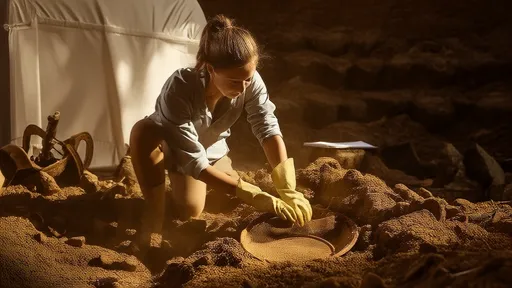
The morning mist still clung to the valley as our team of archaeology volunteers gathered at the dig site, our breath visible in the crisp autumn air. What began as routine soil sifting would soon reveal fragments of lives long forgotten—each speck of pottery, each discolored stone whispering secrets from centuries past. This is the quiet magic of archaeological fieldwork, where history emerges not in grand revelations but through patient accumulation of mundane details.
The rhythm of the sieve becomes a meditation, the repetitive motion of shaking wire mesh lulling the mind into a state of heightened awareness. At first, the contents appear uniform—clumps of earth, pebbles, the occasional root—until a trained eye catches the subtle difference. A fingernail-sized shard with a curved edge isn't natural stone but terracotta, its surface worn smooth by time yet still bearing the faintest trace of a painted motif. Nearby, someone gasps as they uncover a corroded metal object that might have been a hairpin or a small tool, its original function now open to interpretation.
Seasoned archaeologists teach volunteers to read the soil like pages of a book. The darker, charcoal-rich layers speak of ancient hearths; the compacted sections reveal walking surfaces trodden by generations. One volunteer's journal describes finding a concentration of fish bones and shells in what appeared to be a domestic refuse pit, suddenly making tangible the dietary habits of a medieval fishing community. Another writes of the emotional impact of uncovering a child's toy—a crude wooden figure—its simplicity underscoring the universality of childhood across millennia.
What fascinates most isn't the museum-quality artifacts (though finding those certainly quickens the pulse) but the ordinary debris of daily existence. A broken comb's teeth, a worn spindle whorl, a fragment of a cooking vessel blackened by fire—these form the true mosaic of history. Specialists can determine where clay was sourced, what crops were cultivated from seed remnants, even reconstruct trade routes from exotic materials found far from their origins. One diary entry marvels at how a single stratum containing olive pits and grape seeds rewritten assumptions about agricultural practices in Roman Britain.
The physical labor becomes secondary to the psychological time travel inherent in handling these remnants. A volunteer describes holding a roofing tile still bearing the paw print of a dog that walked across it while the clay dried two thousand years prior—a moment of connection transcending centuries. Another reflects on uncovering dozens of oyster shells near what was once a tavern, hearing echoes of boisterous meals in the crumbled walls. The smallest finds often carry disproportionate emotional weight: a bead from a necklace, a gaming piece, a scribbled inscription on pottery that some ancient hand touched with the same casual familiarity we might jot a grocery list.
Modern technology intersects with ancient dirt in surprising ways. Volunteers record finds with GPS precision, photograph artifacts in situ with specialized lighting, and participate in flotation processes that recover plant remains invisible to the naked eye. Yet the most profound moments remain stubbornly low-tech—the collective intake of breath when someone brushes dirt from an intact object, the silent reverence when human remains are encountered, the way afternoon sunlight slants across a trench to illuminate some long-buried surface exactly as it might have centuries ago.
As the seasons pass, volunteers develop what one journal calls "archaeologist's eyes"—the ability to spot meaningful irregularities in apparently featureless soil. They learn that context is everything: a lone coin means little unless you know whether it was found in a marketplace, a grave, or a drainage ditch. The diary of a retired teacher contains a poignant passage about finding a bronze ring in the foundation trench of a collapsed wall, sparking speculation about whether it was accidentally dropped by a builder or deliberately placed as a ritual offering for protection.
Perhaps most surprisingly, these fragments reshape not just our understanding of the past but our perception of time itself. Handling objects last touched when the Roman Empire flourished or when Viking longships prowled the coasts produces what one volunteer describes as "temporal vertigo"—the dizzying realization that our own era will one day be represented by similarly mundane debris. A plastic pen cap buried today might someday puzzle future archaeologists as much as an enigmatic bronze artifact puzzles us now.
The work continues, sieve by sieve, square meter by square meter. Volunteers joke about becoming addicted to the process, to that electric moment when the ordinary becomes extraordinary. Their diaries fill not just with technical observations but with philosophical musings—on mortality, on cultural continuity, on the strange intimacy of touching what others made and used and lost. In the end, the greatest discovery isn't any single artifact but the humbling realization that history isn't something distant and abstract. It's in our hands, literally, one carefully sifted fragment at a time.

By /Jul 16, 2025

By /Jul 16, 2025
By /Jul 16, 2025

By /Jul 16, 2025

By /Jul 16, 2025
By /Jul 16, 2025
By /Jul 16, 2025
By /Jul 16, 2025

By /Jul 16, 2025

By /Jul 16, 2025
By /Jul 16, 2025

By /Jul 16, 2025
By /Jul 16, 2025
By /Jul 16, 2025

By /Jul 16, 2025

By /Jul 16, 2025
By /Jul 16, 2025
By /Jul 16, 2025

By /Jul 16, 2025

By /Jul 16, 2025
