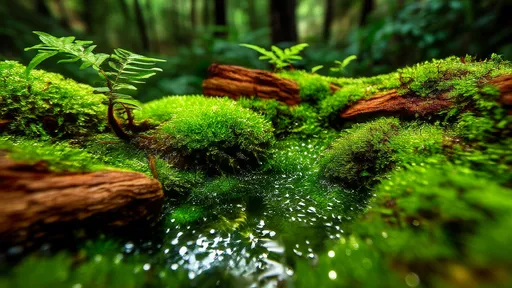
Deep in the heart of the rainforest, where sunlight filters through a dense canopy in fractured beams, an entire universe thrives unnoticed. On the moss-covered stone walls, miniature jungles unfold—a labyrinth of emerald tendrils and velvety cushions that form intricate living maps. These are not mere stains of green but thriving ecosystems, each tuft a microcosm of survival and symbiosis. To kneel before these stones is to peer into a world where time moves differently, where the slow pulse of growth and decay writes stories in chlorophyll.
The texture of moss is deceptive. From afar, it appears as a uniform carpet, soft and undemanding. But up close, it reveals itself as a fractal masterpiece—a colony of tiny stems and leaves, each perfectly adapted to harvest moisture and light. Some species resemble miniature ferns, their fronds unfurling like the curled fingers of a newborn. Others mimic starfish, splaying radially to maximize surface area. These are ancient organisms, descendants of the first plants to creep onto land over 400 million years ago, yet their resilience feels freshly miraculous when observed clinging to rain-slicked rock.
Water is both architect and artist here. Morning mists condense into droplets that roll like mercury across the moss’s waxy surface tension, irrigating communities too small for roots. In this realm, gravity is negotiable; capillary action defies verticality, allowing moss to scale sheer cliffs where other plants would perish. The stone itself becomes a canvas—its mineral composition subtly altering the hue of the green growth. Iron-rich veins might host deeper jade colonies, while limestone outcrops bleach mosses to a pale, almost luminous celadon.
Beneath a hand lens, the moss transforms into a surreal landscape. Sporophytes rise like translucent obelisks, their capsules pregnant with spores ready to catch the wind. Springtails, smaller than pinheads, navigate this terrain like boulder-jumping mountaineers, their armored bodies glinting between stems. Tardigrades—those legendary microscopic "water bears"—lurk in the moisture films, surviving extremes that would vaporize most life. This is no passive greenery but a stage for predation, reproduction, and chemical warfare: some mosses secrete antimicrobial compounds, sculpting microbial communities in their immediate vicinity.
The rainforest’s stone walls serve as accidental archives. Moss growth patterns map historical rainfall—denser clusters betraying years of abundant mist, sparse patches hinting at droughts unrecorded by human instruments. Certain species only flourish where air purity reaches near-absolute levels, their presence acting as a bioindicator for untouched environments. In this way, the moss becomes both historian and prophet, its silent growth encoding data about past and future climates.
To witness moss is to recalibrate one’s sense of scale. A single square inch may contain twenty distinct microhabitats: a sunlit crest where photosynthesis runs at full throttle, a shaded trough where cyanobacteria fix nitrogen in the dimness, a decaying section where fungi unravel organic matter into new soil. These processes normally escape our notice, yet they underpin entire food webs. Birds pluck strands for nest lining; tree frogs lay eggs in moisture-trapping clumps; orchids anchor their seeds to mossy nurseries. The stone wall is not a backdrop but a central actor in the rainforest’s drama.
Modern microscopy reveals even deeper layers of wonder. Fluorescent staining shows chloroplasts streaming within moss cells like emerald constellations, their movements choreographed to light gradients. Time-lapse photography captures the slow-motion ballet of leaf orientation—each tiny adjustment optimizing angle to the sun. Scientists now suspect that moss networks communicate through chemical signals, relaying warnings about herbivores or shifting resources to stressed sections of the colony. Such findings blur the line between individual and collective, challenging our definitions of intelligence.
Perhaps the most humbling realization is how these miniature worlds persist without acknowledgment. They require no pollinators, no deep soil, no human intervention. A moss colony severed from its substrate can desiccate for decades, only to resurrect within hours of rehydration. This is life pared down to its essence: tenacious, opportunistic, and breathtakingly beautiful in its simplicity. The rainforest’s stone walls do not merely host moss—they are rewritten by it, their surfaces slowly transformed into living parchment where the oldest stories on Earth continue to unfold, one cell division at a time.
For those who pause to look, these green maps offer more than aesthetic pleasure. They are masterclasses in adaptation, demonstrations of how life proliferates in the margins. The next time you pass a rain-darkened stone, consider kneeling. Bring your eye close enough to smell the vegetal tang of photosynthesis in progress. The view will humble you—an empire in a thimble, a forest in a footprint, a reminder that grandeur thrives not despite smallness, but because of it.

By /Jul 16, 2025

By /Jul 16, 2025
By /Jul 16, 2025

By /Jul 16, 2025

By /Jul 16, 2025
By /Jul 16, 2025

By /Jul 16, 2025

By /Jul 16, 2025

By /Jul 16, 2025

By /Jul 16, 2025

By /Jul 16, 2025

By /Jul 16, 2025

By /Jul 16, 2025
By /Jul 16, 2025

By /Jul 16, 2025

By /Jul 16, 2025

By /Jul 16, 2025

By /Jul 16, 2025

By /Jul 16, 2025

By /Jul 16, 2025
