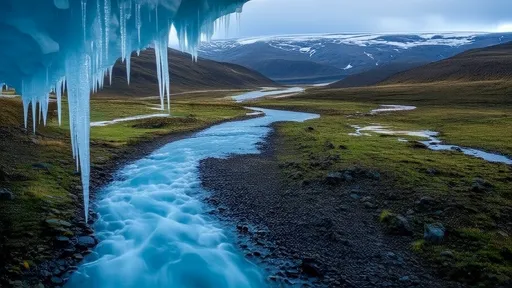
The glacial tongue glistened under the midnight sun, its fractured edges weeping crystalline meltwater into the milky turquoise stream below. Our team of hydrologists and adventurers tightened the straps on our bright orange drysuits, exchanging nervous grins as we pushed the inflatable raft into the icy current. This seven-day journey would trace the liquid pulse of the climate crisis – from the crumbling face of the Sólheimajökull glacier to the raging Jökulsá river, where meltwater becomes myth.
The river's first whispers came as a deceptive trickle, ankle-deep channels braiding through black volcanic sand. Within hours, these tentative threads wove themselves into a muscular torrent, carrying us past towering basalt columns where Arctic terns dove like white daggers. The water smelled of crushed flint and ancient air – the scent of ice surrendering to time. By dusk, we'd learned to read the river's moods in the changing pitch of rapids, the way eddies formed liquid hieroglyphs that predicted coming obstacles.
At the abandoned sheepherder's hut near Hvolsvöllur, we met Dr. Elín Jónsdóttir, who'd been taking daily water samples since 1997. Her data showed the stream's pH dropping alarmingly as glacial flour – fine rock particles ground by ice – altered the river's chemistry. "This water remembers everything," she said, holding up a vial that swirled with sediment. "The 1783 Laki eruption. The first diesel engine in Reykjavík. Last summer's heatwave. It's all written here in minerals."
Day three brought us to the forbidden canyon, where meltwater had carved a 200-meter-deep gash through rhyolite cliffs. The river here moved with eerie silence, its surface a mirrored obsidian that doubled the towering walls. Our GPS units blinked erratically as the canyon's magnetic fields interfered with signals, forcing us to navigate by the water itself – memorizing the way current tongues licked certain rock formations, how whirlpools marked submerged boulders. When night fell, bioluminescent algae set the riverbanks glowing electric blue, as if the land itself had become a circuit board.
The river's personality shifted dramatically after merging with geothermal springs near Hveragerði. Suddenly we were floating through steam clouds, the water temperature fluctuating between numbing cold and bathtub warmth. Rainbow trout darted between thermal vents, their scales glittering like discarded jewelry. Local legend claims these mixing zones birth nýr lífs – "new life" – though what we witnessed were surreal chemical reactions: orange iron deposits blooming across rocks, strands of extremophile bacteria waving like dreadlocks in the current.
By the fifth morning, the river had grown muscular with tributaries, its voice deepening to a constant roar. We passed the rusted skeleton of a 1940s-era hydroelectric dam, its concrete teeth grinning uselessly at the sky. "Modern glaciers produce too much water too fast for twentieth-century infrastructure," shouted engineer Þorvaldur Brynjarsson over the rapids. He's part of a team designing "living dams" using genetically modified bamboo – a controversial experiment to manage floodwaters without further disrupting ecosystems.
The final descent into Jökulsá canyon tested every ounce of our skill. House-sized icebergs calved from a hanging glacier upstream, forcing us to slalom between spinning white monsters. One raft got pinned against a mid-channel boulder for terrifying minutes until a surge of meltwater from an afternoon heatwave lifted it free. That evening around the campfire, Inuit team member Nuka Bergstrom taught us to listen to ice – the pops and groans that reveal whether a berg will roll or hold steady. "Western science calls this hydroacoustics," he laughed. "My people just call it survival."
At journey's end, where the river kissed the Atlantic, we released biodegradable drift cards painted with UV-sensitive ink. Over the coming months, beachcombers would find these from the Faroe Islands to Svalbard, each card telling part of the glacier's story through its fading colors. As our raft deflated with a sigh, I pressed my palm against the water one last time. This liquid had been solid ice when Vikings first settled Iceland. Now it flowed toward an uncertain future – and we, like all creatures, would follow where the meltwater led.
By /Jul 16, 2025
By /Jul 16, 2025
By /Jul 16, 2025

By /Jul 16, 2025

By /Jul 16, 2025
By /Jul 16, 2025
By /Jul 16, 2025
By /Jul 16, 2025
By /Jul 16, 2025
By /Jul 16, 2025
By /Jul 16, 2025
By /Jul 16, 2025
By /Jul 16, 2025
By /Jul 16, 2025
By /Jul 16, 2025
By /Jul 16, 2025
By /Jul 16, 2025
By /Jul 16, 2025
By /Jul 16, 2025
By /Jul 16, 2025
