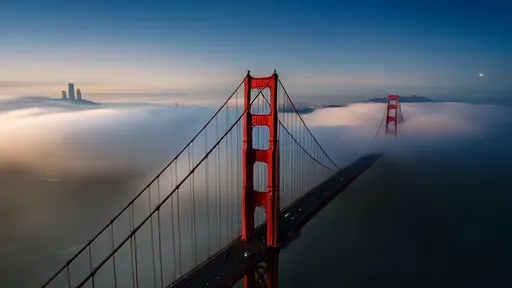
The Golden Gate Bridge, an iconic symbol of San Francisco, presents a unique challenge for navigators and visitors alike when the infamous Bay Area fog rolls in. The thick, swirling mists that frequently envelop the bridge create an otherworldly atmosphere, reducing visibility to near zero and transforming the steel structure into a ghostly silhouette. For those attempting to navigate or observe the bridge under these conditions, specialized techniques and local knowledge become essential.
The Fog’s Unpredictable Nature
San Francisco’s fog is a meteorological phenomenon shaped by the collision of warm inland air and the cold Pacific Ocean currents. This creates the dense, persistent fog banks that locals refer to as "Karl the Fog." The Golden Gate Strait acts as a funnel, channeling these mists inland with startling speed. One moment, the bridge is bathed in sunlight; the next, it disappears entirely behind a wall of white. This unpredictability demands constant vigilance from mariners, pilots, and even pedestrians attempting to traverse the area.
For ship captains, the bridge’s fog horns provide critical auditory cues. The deep, resonant blasts echo across the water, their timing patterns carefully calibrated to help vessels maintain orientation. The south tower emits a single blast every twenty seconds, while the north tower answers with two shorter blasts. These signals cut through the visual obscurity, allowing experienced navigators to triangulate their position even when the bridge’s towers vanish from view.
Land-Based Observation Strategies
Tourists and photographers flock to popular vantage points like Battery Spencer and Fort Point, only to find their views obliterated by the capricious fog. Seasoned observers employ several tactics to maximize their chances of a clear sighting. Many monitor real-time fog prediction maps that analyze temperature differentials between Ocean Beach and downtown San Francisco. When the gradient reaches critical levels, the fog typically materializes within hours.
Some enthusiasts utilize microclimate knowledge, positioning themselves at Hawk Hill where the elevation often places them above the fog layer. From this aerie, they witness the surreal spectacle of the fog pouring through the Golden Gate like a slow-motion avalanche, the bridge’s towers protruding like sentinels from a cotton sea. Others time their visits for late afternoon when solar heating frequently burns off the marine layer, creating dramatic partial reveals of the bridge’s span.
Technological Aids and Traditional Wisdom
Modern technology has introduced new tools for fog navigation around the bridge. The Port of San Francisco’s AIS (Automatic Identification System) allows vessels to track each other’s positions electronically when visual confirmation becomes impossible. Meanwhile, the bridge itself incorporates specialized lighting systems. The aviation beacons atop its towers switch to high-intensity strobes during fog conditions, pulsing through the gloom to warn aircraft.
Yet traditional methods retain their value. Fishermen working the waters beneath the bridge often rely on subtle changes in wind direction and temperature to anticipate fog movements. They note how the fog’s edge sometimes aligns with specific architectural features of the bridge’s towers, using these as impromptu markers. The bridge’s catwalks, normally used for maintenance, take on new significance in fog—their vibration patterns change with wind speed and density, providing tactile feedback about conditions.
The Bridge as Fog Instrument
Remarkably, the Golden Gate Bridge itself functions as a giant fog detection device. Engineers have documented how the structure’s suspension cables accumulate moisture at different rates depending on fog density. This phenomenon inspired the development of experimental "fog harps" that measure water droplet accumulation on vertical wires. Artists too have capitalized on the bridge’s fog interactions, creating installations that capture the play of light through droplets or amplify the bridge’s eerie acoustics during fog events.
For emergency responders, fog presents particular hazards. The California Highway Patrol implements reduced speed limits on the bridge when visibility drops below certain thresholds. Their vehicles employ special infrared systems to detect stalled cars that might otherwise remain invisible until the last moment. The bridge’s pedestrian walkways see increased patrols during fog, as disoriented visitors sometimes wander dangerously close to traffic lanes.
Cultural and Ecological Dimensions
The fog’s relationship with the Golden Gate Bridge extends beyond practical navigation concerns. It has become woven into the region’s cultural identity, inspiring countless photographs, poems, and films. The bridge’s ability to vanish and reappear lends it an almost mythical quality in popular imagination. Environmental scientists note how the fog sustains unique ecosystems on the bridge’s towers, where moisture-loving lichens and mosses flourish in microhabitats created by the constant dampness.
Bird researchers have made surprising discoveries about avian navigation in the bridge’s fog. Certain species appear to use the structure’s low-frequency vibrations—amplified by fog’s acoustic properties—as orientation cues during migration. This finding has prompted new designs for urban structures that might assist rather than hinder wildlife movement in poor visibility conditions.
As climate patterns shift, scientists closely monitor changes in the Golden Gate fog regime. Some models predict decreased summer fog frequency, which could alter everything from bridge maintenance schedules to the iconic visual identity of San Francisco itself. For now, though, the dance between fog and bridge continues—a daily drama of disappearance and revelation that challenges navigators, delights observers, and reminds all witnesses of nature’s power to transform human creations into fleeting specters.

By /Jul 16, 2025
By /Jul 16, 2025
By /Jul 16, 2025

By /Jul 16, 2025

By /Jul 16, 2025
By /Jul 16, 2025
By /Jul 16, 2025
By /Jul 16, 2025

By /Jul 16, 2025
By /Jul 16, 2025
By /Jul 16, 2025
By /Jul 16, 2025
By /Jul 16, 2025
By /Jul 16, 2025
By /Jul 16, 2025
By /Jul 16, 2025
By /Jul 16, 2025
By /Jul 16, 2025
By /Jul 16, 2025

By /Jul 16, 2025
